Customer education, Just Browsing, NDIS Policies, Participant or Nominee, Plan Management, Understanding my plan, Understanding NDIS
September 25, 2025
Key Points:
A change of circumstances means your needs, supports, or situation have changed that may affect your NDIS plan.
Two main types of changes: small updates (Plan Variation) or bigger shifts needing a full review (Plan Reassessment).
NDIS may refuse a change if there’s no new evidence, the request is only about extra funding, or existing supports already meet your needs.
You’ll need the right documents, such as evidence, clear explanations, and the correct NDIS form.
The process is step-by-step: review your plan, gather documents, submit the form, and wait for NDIS to update your plan or explain their decision.
Summary:
This article explains what a change of situation is in NDIS and how participants can manage it. It walks through when and why a change may be needed, what to tell the NDIS, and how the process works. It outlines the difference between small plan variations and full plan reassessments, the documents required, and what to expect after submitting a change. The article also highlights reasons why the NDIS might decline a reassessment or variation, helping participants understand what counts as valid evidence. Clear steps are given on completing forms, providing the right documents, and waiting for outcomes, so participants and families know what to do at every stage.
We understand your situation or circumstances may change during your NDIS journey. It is important to keep the NDIS updated with any changes you go through over time. Things can shift quickly, whether it’s your health, living situation, or the support that you need. Letting the NDIA know about these changes is important because it helps make sure your plan still gives you the right supports at the right time.
In this article, we’ll walk you through what a change of situation in NDIS means, when you might need to report one, and how AIIM Choices’ NDIS Plan Managers can support you through the process.
Any Change in your NDIS Plan
Your NDIS plan can mainly change in two situations: when you ask the NDIS to review or reassess your plan, or when the NDIS decides to make any changes to your plan on their own.
The NDIS can do this at any time if they believe it is needed. If not, they will check your plan with you on the reassessment date and decide if any updates are required.
Reassessment Date (NDIS Initiated)
First, let’s talk about the reassessment date because every plan has a reassessment date. On this day, the NDIS looks at your plan with you and decides, according to your current situation, if any changes to your current plan are needed.
In this case, if your plan reaches the reassessment date before the reassessment is completed, your current plan will be extended normally by 12 months. This means you can continue receiving the support until the reassessment is completed.
Plan Reassessment (Participant or Agency Initiated)
If you feel your plan needs to change for any reason, you can contact the NDIS and let them know. They will go through the NDIS plan reassessment process with you, which we will talk about in this article.
This usually happens when something in your life has changed, and your plan needs to reflect that. You can request the NDIS for reassessment at any time when there is a change of circumstances or a change of situation.
What is a Change of Circumstances?
A change of circumstances is when something important in your life has changed, and it affects the NDIS supports you receive. This could be a change in your health, your home, or the level of help you need. It can also include updates to your personal details, like your contact information or the people who support you.
Change of circumstances can be placed into different categories, but the situation of every person is unique in the end.
Letting the NDIA know about any changes in your life is important because it keeps your plan up to date and makes sure it reflects your current needs.
What changes should you tell NDIS about?
Every person is unique, and so is their situation. But let’s list down some of the most common changes that you should notify the NDIS about.
Your contact details, such as your address, phone number or email.
The level of support your family and friends provide.
If there are changes to the functional impact of your disability, meaning you might need more or less support.
You’re starting a new job and need new or different support at work.
You’re going overseas for a long period of time, or you’re moving overseas
You’re moving out of residential accommodation or aged care, and you need different support in your new home.
You receive or claim compensation for an accident or illness related to your disability.
How do I let the NDIA know?
There are a few ways you can inform NDIS about your change of circumstances, and they’re all pretty simple.
You can send NDIS a letter with all the supporting evidence to NDIS directly.
What happens when you notify NDIS about a Change of Circumstance?
First, let’s have a look at different categories wherein these changes may fall under, so that you know exactly what to do in any given situation. Although all this information may feel a bit overwhelming, we will simplify everything for you.
When you first notify the NDIS about the change in your situation or details, the NDIS will conduct an initial assessment depending on your situation.
The NDIA will then decide if your case should fall under one of the following scenarios:
Change in Details – Plan Variation (Section 47a) According to NIDS, variations are when changes to a participant’s NDIS plan can be made without replacing the plan
Change in Situation – Plan Reassessment (Section 48) Reassessments are when the NDIA creates a whole new plan with a participant who has a new end date.
Do you need help notifying the NDIS about a Change of Circumstance?
Let’s walk through what plan variation actually is and what it looks like. Remember when we talked about how any change in your NDIS plan can either be initiated by you or the NDIS directly?
These are the changes in your NDIS plan without a formal plan reassessment as per your change in circumstances. NDIS laws allow the NDIS for plan variation in certain situations. These laws also explain how a plan can be changed in your unique situation.
When you request the NDIS for a plan variation, it is called ‘participant-initiated plan variation’
When NDIS decides to vary your plan, then it is called ‘CEO-initiated plan variation’. In both scenarios, it is a case of a change of circumstances.
The varied plan may be different from what you initially requested, but the NDIS will talk to you about this when they update your plan. NDIS has categorised these changes for plan variation into the following types:
a. Fix a small or technical error
If there is a small or technical mistake in your plan, the NDIS will update your plan to fix it. A small mistake can be either a wrong spelling or a missing word in your plan. A technical error occurs if your supports are calculated in the wrong way or if there is an error in the statement of your goals. The NDIS usually fixes these errors as fast as possible.
For example, in Alina’s plan, the planner accidentally missed adding a zero to the funding amount at the end of her AT funding.
b. Vary your total funding amount
The total funding amount in your plan can be varied in certain circumstances, which may include the following scenarios:
When you need funds in a crisis or an emergency situation
When NDIS receives the requested information after your plan is issued
Your plan reassessment date has been changed
Minor variation in which your total funds are increased
c. Vary your funding component amount(s) and funding periods
If your plan has funding components and funding periods, and your circumstances require changing how your supports are grouped or changes in funding periods, then this will fall under plan variation. However, you should keep in mind that the total funding amount will not be changed in this case.
d. Change the reassessment date of your plan
The reassessment date for every plan is different, and it depends on the unique circumstances of participants. The NDIS will decide if a change of reassessment date is required for your particular case.
Usually, the NDIS will make sure to reassess all the plans every 5 years. If your plan is working well for you, then NDIS might change the reassessment date. This is called plan continuation.
If the reassessment date is changed, then the statement of your support may also change.
e. Update how the funds or other aspects of your plan are managed
Your plan can be updated to change how your funds, or other parts of your plan, are managed. NDIS plans can be self-managed, plan-managed, or agency-managed. Similar to any other plan changes, this change may also be initiated by either you or directly by the NDIS.
If the NDIS has decided to make a change in this regard, they will likely consider if you, your plan manager, your plan nominee, or your child representative:
Are not using the NDIS plan as per NDIS guidelines
Have either been convicted of an offence that is punishable by imprisonment of 2 years or an offence that involves fraud
Have an unreasonable risk
If a request has been initiated by you for changing your plan from self-managed to plan-managed, then this change of circumstance will also fall in this category.
f. Update who must provide support or how support must be provided
The NDIS may specify in your plan about how, when and by whom the support is provided to you or your loved ones. But your situation may change if the provider is no longer providing the specified support, you no longer need that support, or if there is a new provider.
g. Add crisis or emergency supports
If a significant and unexpected change happens in your life, the NDIS may be able to update your plan to add crisis or emergency supports. There are certain criteria that must be met to add crisis or emergency supports in your plan.
A significant change of circumstances in this case can mean a change in your:
Functional capacity – Things you can or can’t do because of your disability.
Informal supports – Your family members, friends or unpaid carers are no longer available to provide support.
Living situation – Any emergency situation in which your living situation has been changed. e.g. natural disasters.
Crisis or emergency situations can be dealt with once-off support or support for a specified time, depending on your situation.
If you have been funded by any other state or territory program for your emergency situation, then the NDIS will not vary your plan.
h. Minor Variations
If your situation requires minor variations, then the addition of supports for either a specified time or on a one-off basis can be requested. The additional support must be different to, or have different outcomes from other supports already in the plan.
These can include repairing your AT equipment, urgent support for a job opportunity before the reassessment date, or your child starting school earlier than planned.
You can also request the NDIS to increase the funding for specific supports that are already in your plan. This may include situations in which you may need home modifications, vehicle modifications or assistive technology.
The funding may also increase if the cost of support has increased, the support is not available in the same form as previously stated in the plan, or getting the support requires extra information or services.
i. Other Circumstances
Some other change of circumstance situations may include the following as well:
Information requested by the NDIS was received after the start of your plan. e.g. Assessment report from your occupational therapist was received after the plan was issued.
Your plan reassessment date has been changed by the NDIS, and your plan has been extended by adjusting the budget without changing the supports.
Change in Situation – Plan Reassessment (Section 48)
You can request an NDIS plan reassessment any time, depending on your current circumstances. Plan reassessment means that a new plan will be issued to you or your loved ones. The NDIS will decide to issue you a new plan based on the information you provide them.
Similar to plan variation, NDIS will do a plan reassessment if there are any significant changes in your life. Some of the things that NDIS will look at for the reassessment request will be changes in your:
Functional capacity
Informal supports
Living situation
Major Changes in Life
Reassessment Date
Changes to Your Right for Compensation
Do you need a Plan Reassessment because of changes in your situation?
So far, we’ve talked about what a change of circumstance means and how it can affect your NDIS journey. Now, let’s look at what is not considered a change of circumstances under the NDIS guidelines.
Sometimes you might feel something should count as a change of circumstance. But in reality, it may not fall into that category. This usually happens when there is a change in your life, but it is not affecting your supports or your disability.
There are also situations where the NDIS may decide not to change your plan, even if you ask for a reassessment or variation. When you make this request, the NDIS will consider if your current plan already meets your support needs, and they will also look at the reasons you have given to them, along with supporting documents.
a. Reasons NDIS Would Decide Not to Do a Plan Reassessment
No New Information or Evidence
The NDIS only changes your funding when your circumstances have actually changed. If there’s no new information or proof that your support needs are different, your plan will usually stay the same. For example, this might be the case when:
You changed your mind about the NDIS supports you want after NDIS approved your plan
There’s no evidence that your disability support needs have changed. That is, you can still do the same things you could do when NDIS approved your plan
There’s not enough evidence to show that you need changes to your NDIS supports, such as more therapy.
Request Is Only About Wanting More Funding, Or NDIS Supports That Other Participants Have
The NDIS generally won’t change your funding just because you want more NDIS supports, or the same supports as other participants. This may include:
More funding because you’ve used all the funding in your plan, even though your situation hasn’t changed
Extra NDIS supports because another participant has these supports
NDIS supports are added to your plan without enough evidence showing why you need them
Funding for NDIS supports that don’t relate to your disability support needs.
Informal, Community, or Mainstream Supports Meet Your Needs
The NDIS will not treat it as a change of circumstances if your needs can be met by friends, family, or other services. For example, if you ask for things:
That are not NDIS supports
That NDIS would reasonably expect family or friends to do for you. For example, short-term care if the family members who usually support you are sick.
Your Plan Is Suspended
The NDIS will not do a plan change if your plan has been suspended. This usually happens after:
You’ve been overseas for more than 6 weeks. However, there are some situations in which NDIS can extend the 6-week period of your plan.
You don’t claim compensation you’re entitled to after NDIS asks you to, for example, after you’ve had an injury.
b. Reason NDIS would decide not to do a plan variation
Some of the most common reasons for NDIS to consider your situation as not a change of circumstance situation are as follows:
Your plan is suspended or ceased
Supports funded by other systems
Illegal or excluded supports
Day-to-day living costs
You have flexible funding left in your plan that can be used
It is to avoid or replace an existing review or appeal pathway
NDIS thinks there is not enough evidence to support a variation
You’ve used all the funds in your plan quicker than specified in your plan, without evidence showing why this was needed
You’re requesting to self-manage or use a registered plan manager, but we think it’s an unreasonable risk to you.
The NDIS will also decide not to vary your plan if they think they should do a plan reassessment instead. The reasons NDIS may decide that your plan needs a reassessment instead of a variation are:
The NDIS varied your plan several times, and your plan still doesn’t meet your needs, so NDIS may need to do a reassessment
The NDIS can’t vary your plan without looking at the other supports in it
Your situation has changed significantly, and you need a reassessment
You want more funding to help with a new or changed goal, and the request is not minor
Your informal, community or mainstream supports can’t meet your needs.
What Documents are Required?
When you ask for a change of circumstances, it’s important to include the right information and evidence. Without supporting documents, your request for a reassessment is unlikely to be approved by the NDIS. So, let’s dive into it and see what some of the necessary documents are and how you can gather them for your NDIS change of circumstances application.
You might have this information yourself, or you might need to get it from a support coordinator or provider. If you have a support coordinator or a specialist support coordinator, NDIS will need a report from them. The report should tell NDIS how your NDIS supports are meeting your needs and helping you pursue your goals.
For children younger than 9, there is an Early childhood provider report form, which is needed. It is the duty of providers to complete this form to tell NDIS about the supports the child has received.
a. Evidence That Meets the NDIS Criteria
Documents should show how your request links to the reasonable and necessary supports criteria defined by the NDIS. You’ll need proof that your situation has changed, and this could include:
Medical or Specialist Reports Updated assessments or notes from your GP, specialist, or allied health professionals (e.g. physiotherapist, occupational therapist) that explain how your needs have shifted.
Functional Capacity or Behavioural Assessments Reports like Functional Capacity Assessments can be very helpful if your daily function or support needs have changed significantly.
Letters from Service Providers Notes or statements from your current providers (e.g. therapists or support services) describing how your circumstances or support requirements have evolved.
b. Documented Information Explaining the Change
Some changes may include:
Moving home or shifting living arrangements
A new diagnosis or a worsening condition
Changes in the support you receive from family or friends
A change in employment, education, or financial status
You must submit your evidence with the official NDIS form, known as the Change of Details or Change of Situation form. It’s available on the NDIS website or through your Local Area Coordinator (LAC) or support coordinator.
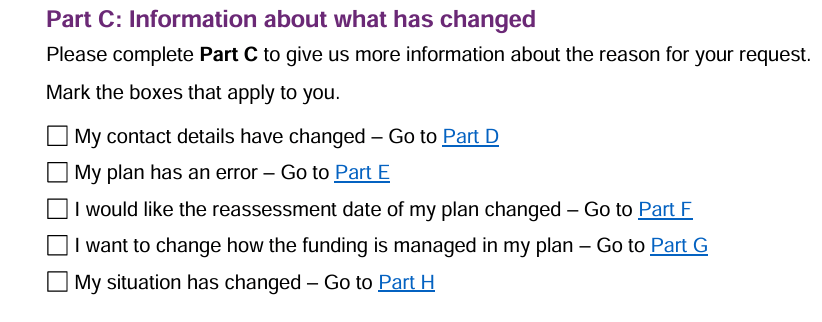
We previously discussed in our article about different situations in which you can notify the NDIS about your change of circumstances. As per your situation, in part C of the change of details or change of situations form, you can select one of the following options as shown in the snippet below.
d. Putting It All Together
Make sure your submission includes:
A fully completed form
Detailed explanations of what has changed and why
Clear supporting documents that align with your request
Why this matters
NDIS will not act on your request unless it’s backed by clear, relevant evidence. Missing or vague documentation can delay your request or result in it not being approved.
How to Submit an NDIS Change of Circumstances
1. Review Your Current Plan and Situation
Before you make a request for a change of circumstances, it’s a good idea to go over your current NDIS plan carefully. Think about which parts of your supports or funding might be affected by your new circumstances. This will make it easier for you to collect the right information when you request an update.
2. Provide the right evidence
In most situations, you’ll need to provide documents that support your request. These might include medical reports, assessments, or letters from your service providers that show how your circumstances have changed.
For example, if your health has declined, you’ll need medical evidence to explain why extra support is needed. So, always gather the right evidence before you apply for change of circumstances.
3. Complete the NDIS Change of Circumstances Form
You can find the NDIS change of circumstances form on the NDIS website, or you can ask your Local Area Coordinator (LAC) or support coordinator for a copy. The form will ask you to explain what has changed, when it happened, and how it affects your support needs.
4. Submit the Form
After you’ve filled in the form and collected the required documents, you can submit everything to the NDIS. This can be done through your myGov account linked to the NDIS participant portal, or by sending it to the NDIS by mail or email. It’s a good idea to keep a copy of what you send for your own records.
5. Wait for Plan variation or Reassessment and Receive Your Updated Plan
After you submit the form, the NDIS will review your plan. This can take some time, and they may ask you for more information or another assessment to fully understand your new circumstances. Once the review is finished, you’ll receive an updated plan that shows your new support needs. If your change means you need more funding or services, these will be included in the updated plan.
What happens next?
Once the NDIS decides to change your plan, you’ll receive a copy of it along with a letter explaining the reasons for the decision. If your plan has been varied, you’ll get the updated copy within 7 days of the change starting. If a new plan has been approved, you’ll receive it within 7 days of approval.
Understanding a change of circumstances and knowing how to handle it is an important part of your NDIS journey. We’ve looked at what a change of circumstances means, when it applies, and the steps involved in letting the NDIS know. You now know what documents may be needed, how to submit the form, and what happens after you make a request.
Remember, not every situation will be treated as a change, but when it is, the NDIS will review your plan and make sure your supports reflect your current needs.
At AIIM Choices, we are here to support you through every step of the process. As part of our NDIS Plan Management services, we listen, we care, and we want to make sure you continue receiving the right supports without interruption.
Feel free to reach out to us if you have any questions about your plan or need help with a change of circumstances.
Catch up on the most important headlines with a roundup of essential NDIS stories, delivered to your inbox monthly.
email address
Connect with AIIM Choices
Complete this form and one of our team will be in touch with you. Want to talk to someone? Speak with our friendly team of experts on 1800 878 978 8.00am to 5.00pm Monday – Friday.
You can get started in three easy steps.
"*" indicates required fields
Is there anything we can help you with before you cancel?
If you have questions or need some advice simply click the Request a Call button and one of our NDIS specialists will give you a call shortly.